
A gentle cradle : Protecting satellites from vibrations
Dübendorf, 22.09.2026 — A rocket launch is not for the faint of heart – and certainly not for sensitive electronics either. Nevertheless, satellites must survive the vibrations during launch unscathed. In collaboration with the Swiss space company Beyond Gravity, Empa researchers have developed a solution to mitigate these dangerous vibrations.
“Trois, deux, un – top!” The countdown ends, the engines fire up, and the Ariane 6 lifts off from its launch pad at the Kourou Space Center in French Guiana. On board the rocket: a weather observation satellite from the European Space Agency (ESA). The satellite is designed to provide information on temperatures, clouds, ocean surfaces, winds, and air quality, thereby enabling more accurate weather forecasts than ever before.
To fulfill its mission, it carries – like most satellites – a wealth of sensitive sensors, measuring instruments, and communication technologies. All these electronics must not only withstand the harsh conditions in space but also endure the enormous forces generated during the rocket’s launch. It is not the acceleration that causes the biggest issue, but rather the vibrations.
As the Ariane 6 ascends into Earth’s orbit, it undergoes so-called stage separations where it gradually jettisons its large solid boosters, fuel tanks and the payload fairing which protects the satellite at the tip of the rocket during launch. Small explosive charges safely push the now superfluous components away. This process generates sudden shocks and vibrations that are transmitted through the rocket’s structure to its sensitive payload.
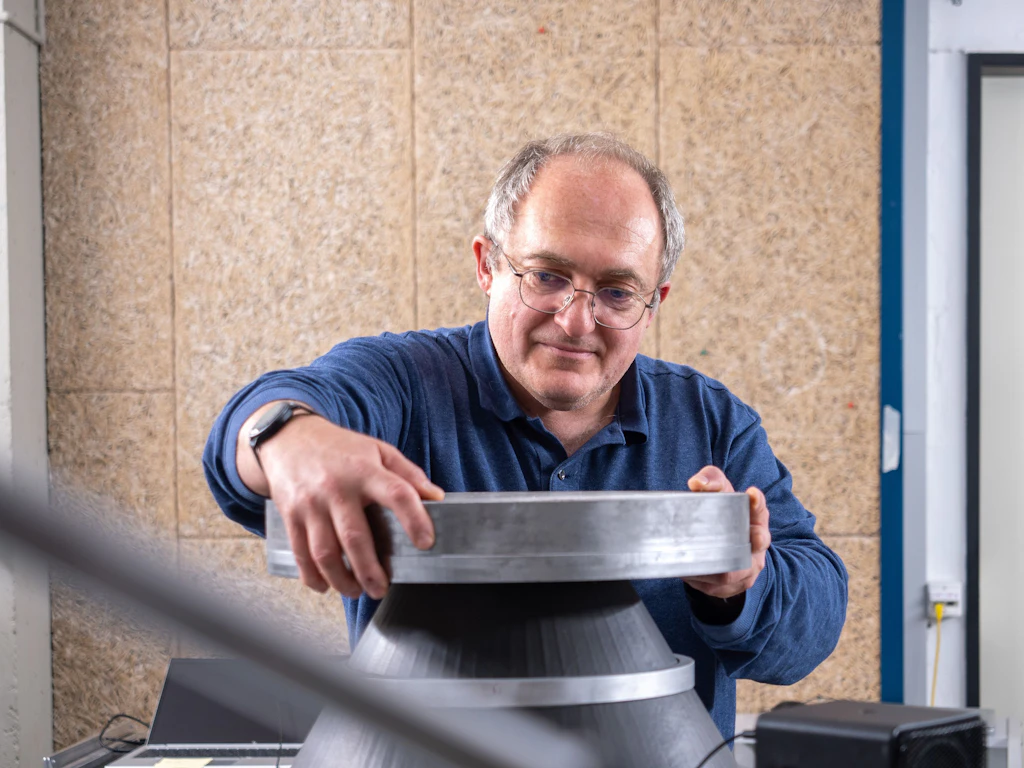
Together with the Swiss space company Beyond Gravity, Empa researchers led by Andrea Bergamini from Empa’s Acoustics / Noise Reduction laboratory have been searching for a way to reduce these damaging vibrations. Their research project was supported by Innosuisse, the Swiss Innovation Agency. The researchers focused on the so-called payload adapter, which Beyond Gravity manufactures for the Ariane 6, among other applications.
An unusual crystal
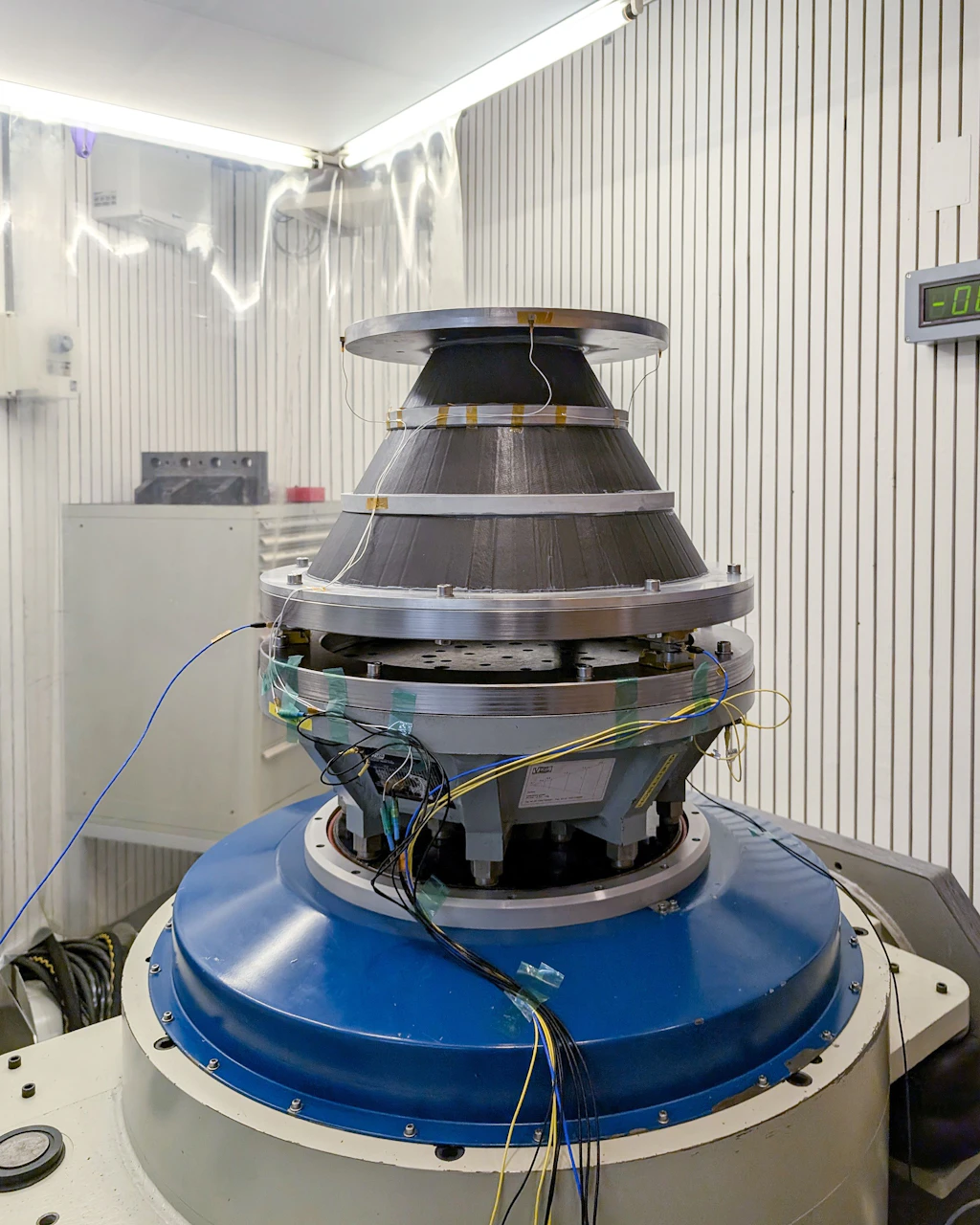
The Payload Adapter System (PAS) is shaped like a truncated cone made of composite material. At the bottom, the component is connected to the rocket; at the top, it is connected to the payload, which may consist of one or more satellites or space probes. “A PAS must be lightweight and rigid,” explains Bergamini. Spring elements, such as those used on Earth to dampen vibrations, are therefore out of the question. Instead, the researchers from Bergamini’s team turned to a concept from acoustics: so-called phononic crystals.
“Depending on their structure, conventional crystals can reflect, scatter, or diffract light in very different ways,” Bergamini explains. Phononic crystals take advantage of precisely this property of crystal structures, but for sound waves. Whereas light waves oscillate in the nanometer range, sound has wavelengths ranging from a few centimeters to several meters. Accordingly, the structures of phononic crystals are also larger. What they have in common is that they redirect, reflect, or scatter vibrations within specific frequency ranges.
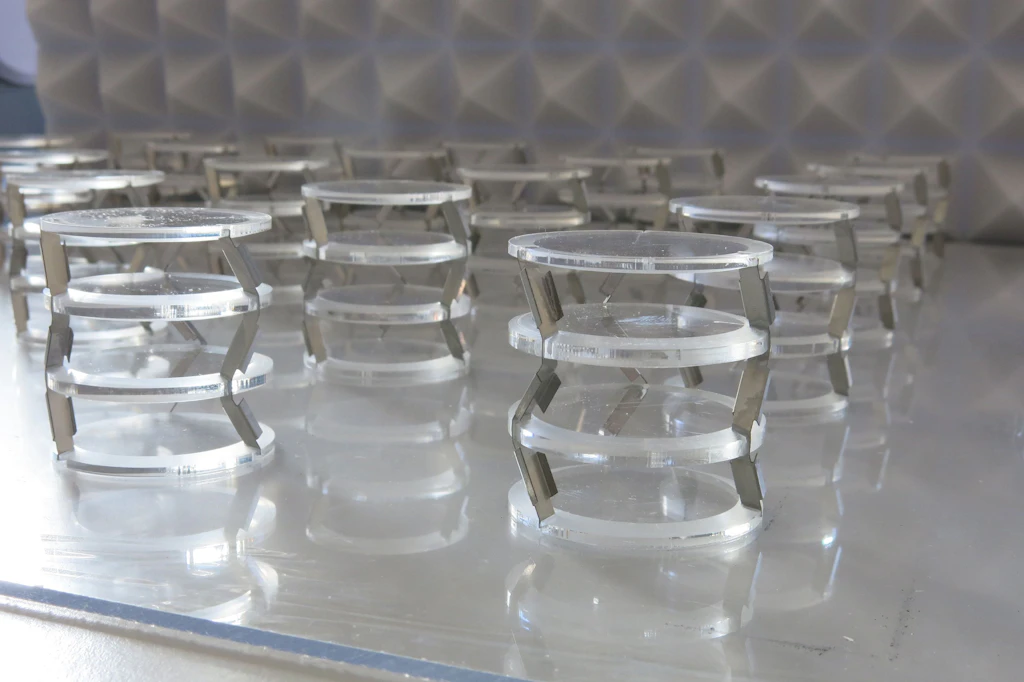
For the payload adapter, the researchers modeled their design after a crystal structure they had developed themselves a few years ago. The crystals consist of a stack of rotatable “plates” connected by a framework that allows for rotational movement. Incoming vibrations along the crystal’s longitudinal axis are thereby converted into rotational movements of the relatively heavy and inert disk elements, thus dampening them.
The fiber makes the difference
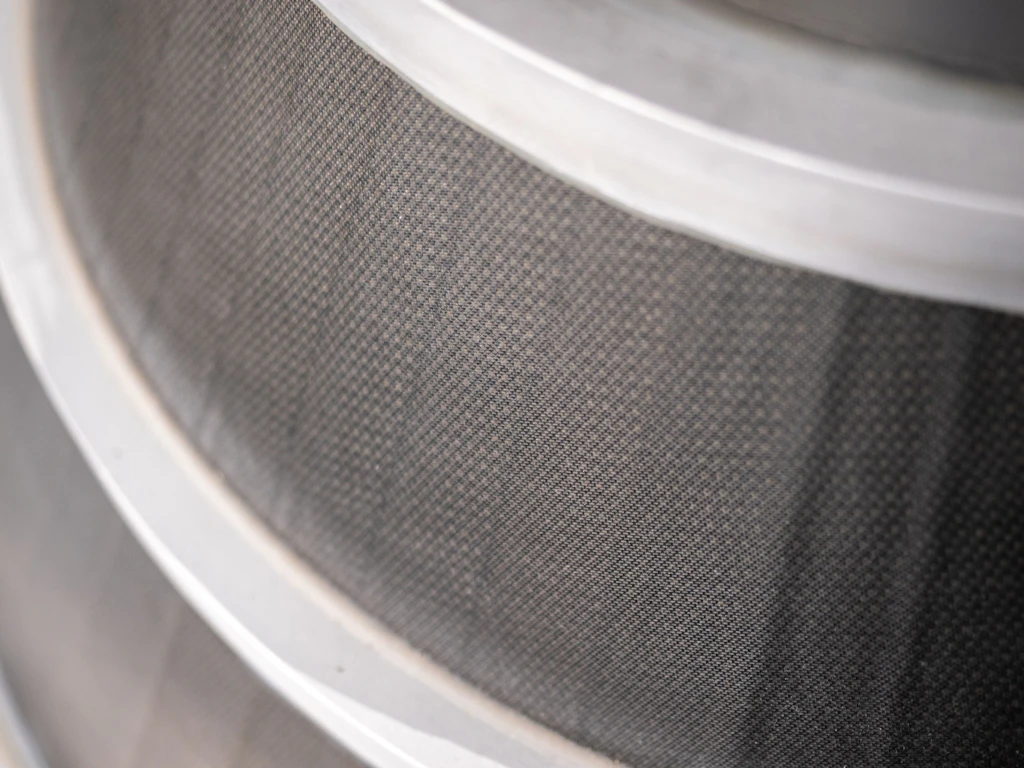
The challenge was to integrate the crystal structure into the PAS in such a way that it would neither become too heavy nor lose stiffness – and, of course, the proposed solution had to be industrially feasible and cost-effective. After several experiments, the Empa researchers came up with a clever idea: Instead of incorporating phononic crystals into the PAS, they transformed the entire PAS into a phononic crystal. Aluminum rings serve as the rotating elements, while carbon-fiber-reinforced plastic – from which the PAS is made anyway – acts as the connecting element. This also allowed the Empa researchers to demonstrate an industrially viable method for manufacturing phononic crystals: These no longer need to be produced through complex 3D printing of intricate geometries.
By strategically aligning the carbon fibers in the composite, the researchers succeeded in creating a structure that allows for slight rotational movements of the aluminum rings while remaining lightweight and rigid. Both in simulations and in experiments with a prototype, the new PAS structure was able to “swallow” particularly dangerous low-frequency vibrations. Beyond Gravity has filed a patent application for the invention: In a single step, the team was able to add a new function to the PAS while simultaneously solving a major challenge related to the production of phononic crystals.
Before the new PAS can be mounted on a rocket, it must be further refined and optimized. According to Bergamini, this effort is worthwhile: “If we can better protect satellites against vibrations, we can send more sensitive measuring instruments into space – and possibly even adapt the requirements for building future satellites so that they become more capable and less expensive,” says the researcher.
Further information
Dr. Andrea Bergamini
Empa, Acoustics/Noise Control
Phone +41 58 765 44 24
andrea.bergamini@empa.ch
Dr. Giulio Molinari
Chief Engineer PLF
Beyond Gravity Schweiz AG
giulio.molinari@beyondgravity.com
Technology Days 2026
Although many people are not aware of it, Switzerland is a spacefaring nation. As a founding member of the European Space Agency ESA, it has helped shape European space exploration from the very beginning. It supplies key technologies for launching vehicles and satellites; no Ariane rocket flies without technology from Switzerland. Over the decades, a small, highly specialized, and internationally networked space industry has emerged here. At the Technology Days 2026, representatives from research, industry and government agencies will showcase where Swiss space exploration stands today and what opportunities are opening up for technology, the economy, and society.
The event will take place on September 22 at the Palais de Rumine in Lausanne in French and on September 24 at Empa in Dübendorf in German. www.swissengineering.ch/tage-der-technik